

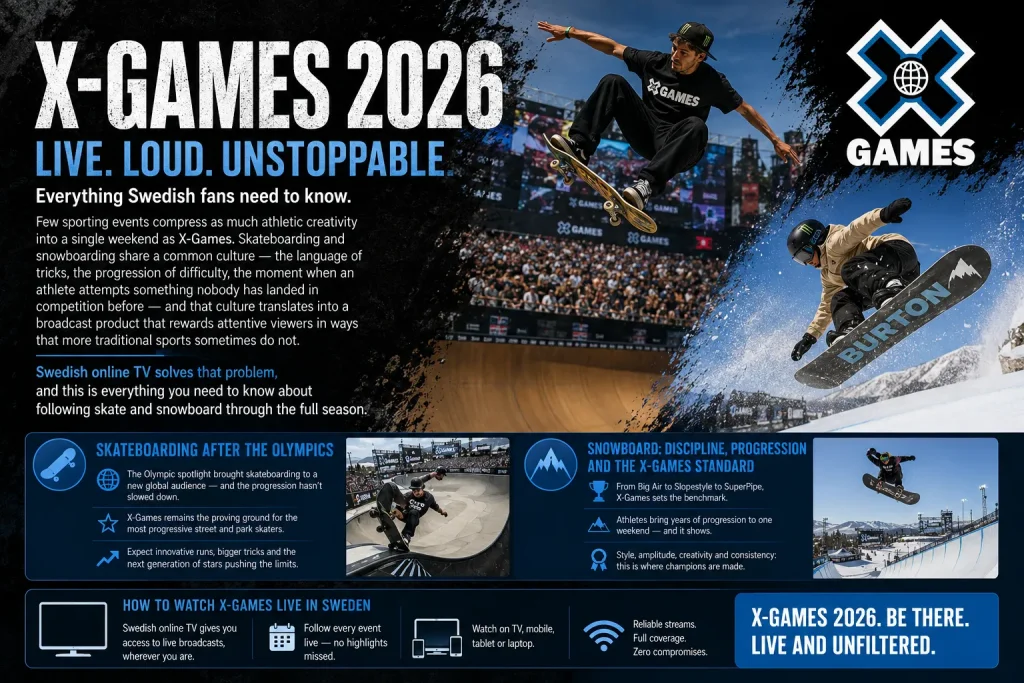
Few sporting events compress as much athletic creativity into a single weekend as X-Games. Skateboarding and snowboarding share a common culture — the language of tricks, the progression of difficulty, the moment when an athlete attempts something nobody has landed in competition before and that culture translates into a broadcast product that rewards attentive viewers in ways that more traditional sports sometimes do not. For Swedish fans who want to follow every X-Games competition live in 2026, the challenge is no longer the sport itself but finding it reliably. Swedish online TV solves that problem, and this is everything you need to know about following skate and snowboard through the full season.
X-Games is not simply a competition. It is the event that legitimized action sports as broadcast television, first in the United States in the mid-nineties and then progressively across the world as skateboarding and snowboarding grew from subcultural pursuits into globally recognized athletic disciplines. The format best trick, halfpipe, slopestyle, street was designed for television as much as for athletes, with judging criteria that reward both technical difficulty and creative expression in a ratio that produces compelling sport to watch.
The summer and winter editions of X-Games run on separate calendars, meaning a viewer who follows both skateboarding and snowboarding has live event coverage spread across most of the year. Summer X-Games typically take place in July or August, covering skateboarding street, park and vert alongside BMX. Winter X-Games runs in January or February with snowboard halfpipe, slopestyle, big air and snowboard street as the headline disciplines. In 2026 both editions carry particularly high stakes following the Los Angeles Olympics, where skateboarding and snowboarding again confirmed their status as mainstream international sports.
Skateboarding’s Olympic journey has changed how the sport is perceived as a broadcast product without changing what makes it compelling to watch. The technical progression that happens in a single competitive season is extraordinary — tricks that were considered at the limit of human possibility five years ago are now baseline qualification requirements in the best street and park competitions.
X-Games street skateboarding rewards the ability to generate speed, control the board through complex manual and grind combinations, and execute powerful flip tricks at a level of consistency that separates the finalists from everyone else. Park skateboarding takes place in a bowl format where amplitude, flow and variety of tricks across the entire structure determine scores. Vert — skating a full halfpipe is the discipline with the oldest X-Games history, and it remains the format where the most dramatic individual moments occur, partly because the consequences of a failed trick at the top of a twelve-foot halfpipe are as visible as the trick itself.
Swedish skateboarding has a strong grassroots foundation, and Swedish fans following the sport internationally do so with genuine technical understanding. The difference between a clean landing and a slightly hung-up back truck is not lost on a Swedish audience that grew up skating. That informed viewership makes following X-Games on a platform with quality live streaming — rather than social media clips considerably more rewarding.
Snowboard halfpipe is the discipline where X-Games carries the deepest history. The event has been part of Winter X-Games since the first edition, and the progression of what is considered competitive has been consistent and dramatic. Runs that would have won gold in the early years of the competition would not qualify for today’s finals. The current generation of halfpipe riders combines amplitude measured in meters above the lip with technical spins and grabs that require precise body position during multiple rotations.
Slopestyle is the discipline where snowboarding as a broadcast product reaches its widest audience. A well-designed slopestyle course gives athletes a sequence of features — rails, boxes, jumps that they can approach with different lines and different tricks, meaning the creative variation between riders is genuinely visible to casual viewers as well as technical fans. No two runs look alike in the hands of elite slopestyle competitors, and that visual variety is part of what makes the format so well suited to streaming.
Big air concentrates the spectacle into single jumps that prioritize maximum amplitude and maximum technical difficulty in combination. The format is simple to follow and produces moments that circulate on social media within minutes of a competition — which in turn drives viewers back to the full broadcast to see the context around the highlight.
Snowboard street is the youngest X-Games discipline and the one that connects most directly to the skateboarding tradition the event grew out of. Urban features, manual pads and rails in a course that looks like a stylized city environment give the discipline a visual identity that is clearly related to skate street while retaining the specific technical demands of doing it on snow in snowboard boots.
Sweden has produced competitive snowboarders and skateboarders who have represented the country at the highest international level for decades. The country’s combination of urban skate culture in its major cities and mountain access in the north creates a sporting ecosystem where both disciplines have genuine depth.
For Swedish online TV viewers, following X-Games is not a passive experience. It connects to a domestic culture around both sports the Swedish skate scene, the mountain resorts that produce competitive snowboarders, the action sports media that has developed alongside the competitive circuits. Having live access to X-Games rather than fragmented highlights gives that connection the substance it deserves.
The time difference between Sweden and X-Games venues in the United States means that live viewing sometimes requires commitment. Winter X-Games in Aspen typically runs evening finals that translate to late night or early morning Swedish time. Summer X-Games finals in California can end well past midnight in Stockholm. A streaming platform with a full on-demand archive that preserves the complete broadcast not a truncated highlights package means Swedish fans can watch every run in full the following morning without the result having been rendered meaningless by social media spoilers.
X-Games is the centrepiece of the action sports broadcast calendar, but it sits within a broader competition landscape that includes the Dew Tour, the FIS Snowboard World Cup, the World Skate Street and Park World Championships, and a growing number of independently organised invitational events. Serious followers of either discipline want access to more than just X-Games, and a Swedish online TV platform with breadth across action sports coverage provides that.
iptvkungen.net gives Swedish viewers access to online TV coverage that spans the action sports calendar alongside the broader Swedish and Nordic sports landscape, making it possible to follow everything from X-Games halfpipe finals to World Cup snowboard slopestyle rounds under a single subscription.
The on-demand function is particularly valuable for action sports, where competitions are often scored in ways that reward multiple viewings. Watching a skateboard park final once gives you the results. Watching specific runs again with attention to technical detail gives you genuine understanding of why the scores fell the way they did. A streaming platform that keeps full event broadcasts available for replay is a meaningfully different product from one that only offers live viewing.
Production quality matters more for action sports than for many other broadcast disciplines. X-Games is produced to a standard that includes slow-motion replay, multi-angle coverage of key tricks and commentary that explains scoring criteria in real time. A streaming service that compresses the broadcast heavily enough to degrade slow-motion replay quality is undermining one of the most important parts of how action sports television works.
Latency the delay between what happens at the venue and what you see on screen — is relevant for live viewing in a way that is specific to competition formats with live judging. When a trick is landed and the audience at the venue reacts before the broadcast catches up, the experience of watching live is diminished. Modern streaming infrastructure has reduced this gap considerably, and a reputable Swedish online TV service operates at a latency level that makes live viewing genuinely engaging rather than frustrating.
Commentary and broadcast language matters for Swedish viewers who prefer to follow sport in their native language. The original X-Games broadcast from ESPN and ABC is in English, and for many Swedish fans this is entirely acceptable given the sport’s roots in American action sports culture. But for younger viewers or those less comfortable in English, a Swedish overlay or commentary option significantly improves the experience.
Following skateboarding and snowboarding through a full competitive season rather than just X-Games gives context that makes the flagship event more meaningful. A halfpipe rider who has been posting strong World Cup results through the winter arrives at X-Games as a genuine title contender rather than an unfamiliar name. A skateboarder who won the Dew Tour street competition a month earlier enters X-Games with momentum that the scoring history makes legible.
Setting up a streaming subscription before the season opens rather than scrambling to find a platform the week of X-Games means you benefit from that context as it builds. The action sports calendar is busy enough in 2026 that there is competitive content worth following from early in the year, and the investment in understanding the field pays dividends when the biggest events arrive.
Swedish online TV platforms with action sports rights carry X-Games summer and winter editions live.
Yes, platforms covering the full X-Games calendar include both editions under a single subscription.
Yes, reputable streaming services archive full event broadcasts so you can watch every run in full the following day.
Platforms with broad action sports coverage include FIS Snowboard World Cup events.
The original broadcast is in English, though some Nordic streaming platforms provide Swedish commentary options for major events.
Established Swedish online TV services with proper server infrastructure maintain HD quality during peak live events.
Skateboarding and snowboarding reward the viewer who pays attention. The difference between a run that scores eighty-five and one that scores ninety-two is visible if you know what to look for — and watching full competitions rather than highlight clips is how you develop that understanding. Swedish online TV in 2026 makes that possible for every X-Games event, every discipline and every final, live or on demand, in the quality the sport deserves. Get the subscription in place before the season opens and follow the progression from the first World Cup rounds to the X-Games medal ceremonies without missing a run.

Jag är Damian Cross, en skribent inom streamingteknik med fokus på OTT-plattformar, videodistribution, streamingprestanda och innovationer inom digitala medier.


