

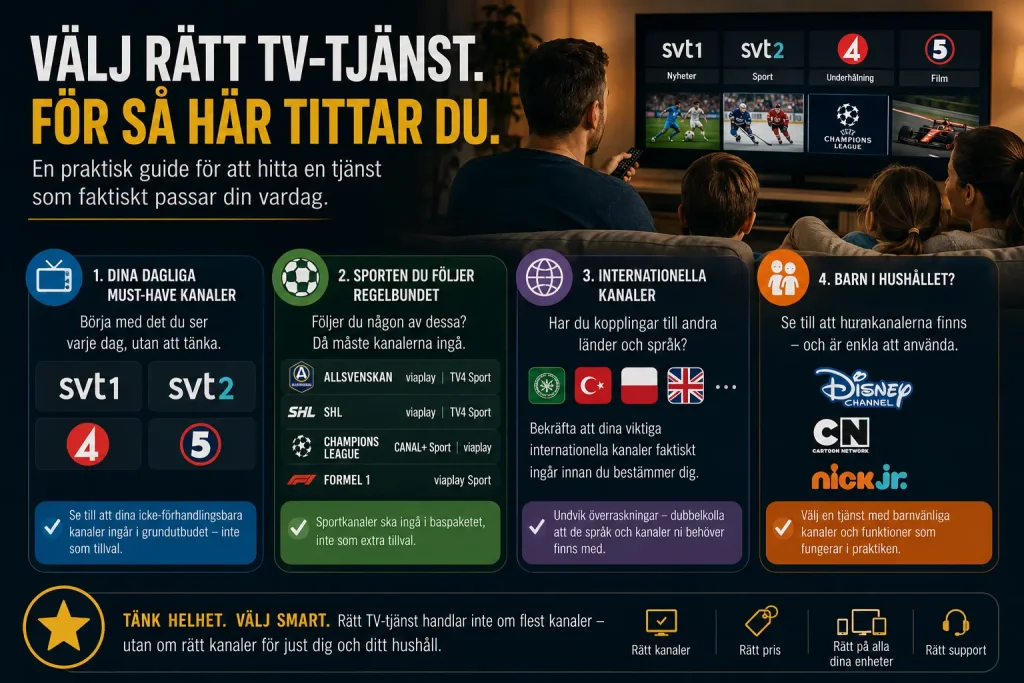
There are more internet-based TV services on the Swedish market today than at any point before, which means choosing between them has become its own challenge. They all claim to offer the most channels. They all describe themselves as Sweden’s best. And they all tend to bury the most important details in a FAQ page rather than putting them front and centre where they’d actually help you decide.
This guide cuts through that and gives you a clear, practical framework for choosing a service that genuinely fits how you actually watch television.
The single biggest mistake people make when comparing streaming services is starting with the channel count on the homepage rather than their own viewing habits.
A service with 15,000 channels means nothing if the eight channels you actually watch aren’t among them. So before you look at any provider’s offering, spend five minutes mapping your real TV consumption
Which channels do you watch every day without thinking about it? SVT, TV4, a specific news channel – these are your non-negotiables. Which sports do you follow regularly, and which channels hold the rights? Allsvenskan is on Viaplay Sport and TV4 Sport. SHL is the same. Champions League is on Canal+ Sport and Viaplay. Formula 1 is on Viaplay Sport. If you follow any of these, those channels need to be in the base package – not listed as potential add-ons. Are there international channels that matter to your household? Many Swedish families have connections to other countries and languages. If Arabic, Turkish, Polish or other channels are part of your regular viewing, confirm they’re actually included before committing. Do you have children? If so, Disney Channel, Cartoon Network and Nick Jr. need to be available and accessible in a way that a child can actually use.
Once you have this list, you have a filter. Apply it to every service you evaluate and it will quickly narrow the field more effectively than any comparison article.
Every service on the Swedish market lists a headline number of channels – often in the thousands. These numbers are real but they’re also largely meaningless on their own as a comparison metric.
What matters is channel depth within the categories that are relevant to you. A service with 10,000 channels but without Viaplay Sport is useless for a Swedish Allsvenskan fan. A service with 500 carefully selected channels that covers all your actual requirements is better than one with 15,000 that buries your priorities in a sea of irrelevant content.
When evaluating a service, ask these specific questions rather than looking at the headline number. Are all Swedish public service channels included? Are the sport channels that hold rights to the leagues I follow in the base package or behind a separate sports add-on? Are the international channels I need consistently available or listed as “may vary by region”? Is on-demand content included alongside live channels, and how large is that library actually?
Price comparison between internet-based TV services is easy to get wrong because the advertised monthly price is rarely the complete picture.
Traditional cable providers like Telia, Tele2 and Telenor typically advertise a base price and then layer sports packages, premium channels and hardware rental on top of it. A household wanting full sport coverage often ends up paying 700–900 kronor per month once everything is added.
With internet-based TV services, the pricing model is often more straightforward, but it’s still worth verifying a few things before committing. Does the listed price include all sports channels, or are they a separate subscription? Is there an activation fee? Are there any differences in content available at different price tiers, or does every package give access to the same full channel lineup? Does the price include a VPN option if you need one for travel?
A service with a slightly higher base price that includes sport genuinely is cheaper than a lower-priced alternative that adds sport as a costly extra.
This is one of the clearest ways to distinguish a confident service from one that relies on inertia to retain customers.
Traditional cable and satellite providers use binding contracts of 12 to 24 months with cancellation fees for early exit. The logic is simple: if a customer wants to leave after three months of dissatisfaction, a cancellation fee makes that painful enough that many simply stay.
A genuinely good internet-based TV service doesn’t need that mechanism. Month-to-month or period-based subscriptions without automatic renewal into longer commitments are a direct signal that the provider is confident enough in their service to let unhappy customers walk away without penalty. That confidence, counterintuitively, is one of the strongest indicators of actual quality.
When evaluating a service, check specifically whether the period you’re considering renews automatically into a longer commitment at the end, and whether there’s any cancellation fee or process beyond simply not renewing.
Picture quality and channel count dominate most streaming service comparisons. Stability is discussed far less often but matters considerably more in practice.
A service that lists 4K quality but stutters during a live Champions League match is a worse experience than a service with strong Full HD that stays completely stable during the same match. The moment that matters most in live sport is precisely the moment when instability is most likely to occur – when hundreds of thousands of viewers are simultaneously streaming the same event and server infrastructure is under its heaviest load.
Before committing to any service, look for specific information about server infrastructure, uptime guarantees and user feedback about streaming quality during popular live events. Positive reviews about picture quality during quiet on-demand viewing are less informative than feedback about stability during a high-demand Allsvenskan derby or a Formula 1 season finale.
A streaming service is only useful if it actually runs properly on the devices you already own. This sounds obvious but is easily overlooked during the comparison phase.
Smart TVs from Samsung, LG, Sony and Philips typically support app installation directly, but app availability and performance can vary between TV models and operating system versions. Older smart TVs may not be supported even if the same manufacturer’s newer models are. If your television is more than six or seven years old, it’s worth checking specifically whether it’s compatible before subscribing.
For older televisions, an Amazon Fire TV Stick or Chromecast with Google TV adds full smart TV functionality for a modest one-time cost. Apple TV 4K is the premium option for Apple households. Mobile apps for iOS and Android, and browser access on Mac and Windows, typically work more consistently across device generations than TV-specific apps.
The practical recommendation: if a service offers any kind of trial or short test period, use it specifically on the device you plan to watch most often, not just on the easiest device to set up.
Customer support is easy to dismiss as a secondary consideration when everything is working. During a live sport event when something isn’t, it becomes the most important feature a service offers.
The questions worth asking before subscribing are straightforward. Is support available in Swedish? Is it available during the hours you’re most likely to watch live sport – evenings and weekends? Is there a live chat option or only email and ticket systems? And do existing customers review the response time positively or describe hours-long waits for help?
A service with strong channel depth but weak or inaccessible support is a meaningful step down in practical experience compared to a service with equivalent content and responsive Swedish-language assistance.
Before subscribing to any internet-based TV service as a Swedish viewer, run through this checklist.
Your essential channels are in the base package, not behind add-ons. The sport channels covering the leagues you follow are included. Price has been checked including all potential extras, not just the headline monthly figure. There’s no long-term binding contract or automatic renewal into one. Device compatibility has been confirmed on the screen you’ll use most. Support is available in Swedish and during the hours that matter to you.
If a service passes all six of these checkpoints, it’s a serious candidate. If it fails on more than one, the headline price or channel count isn’t enough to make it the right choice.
You can review how a complete service measures up against these criteria on the iptvkungen.net.
Channel count matters less than whether it has the channels you actually watch.
Yes, a no-contract service can still be fully complete.
Check reviews and use any trial period to test stability.
Content coverage usually matters more than price.
Check compatibility first and use a streaming stick if needed.
The right choice is the one that actually fits your viewing
There’s no single best internet-based TV service for every Swedish household, because different households watch differently. The right choice is the service whose channel depth, price structure, device compatibility and support quality align with how you specifically watch television – not the one with the most impressive number on its marketing page.
Apply the framework above, run the checklist, and the decision becomes considerably less complicated than the number of options available makes it initially appear.

Jag är Damian Cross, en skribent inom streamingteknik med fokus på OTT-plattformar, videodistribution, streamingprestanda och innovationer inom digitala medier.


