

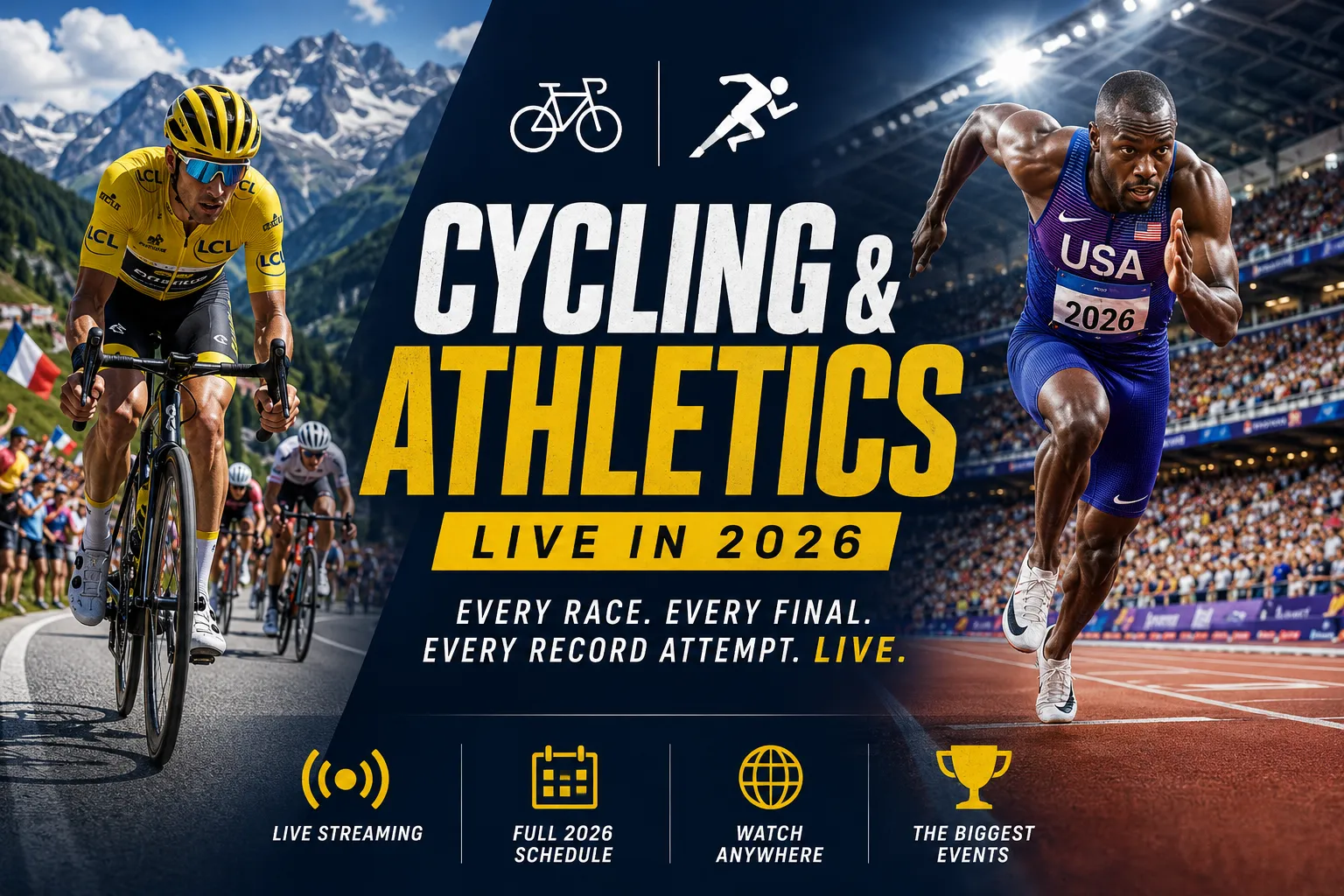
Two sports. Thousands of kilometers of open road. Tracks that have witnessed the fastest humans who ever lived. Cycling and athletics are the purest expressions of what the human body can achieve, and 2026 delivers a season of both that belongs on the very largest stage. If you want to watch every race, every final and every world record attempt live, this guide tells you exactly how to do it.
There is a particular cruelty to watching cycling or athletics on a highlight reel. The story of how a race unfolded – the breakaway that went two hundred kilometers from iptvkungen.net the finish, the pursuit that slowly reeled it in, the sprint that nobody saw coming disappears entirely when compressed into ninety seconds of edited footage.
Athletics is even less forgiving. A world record in the hundred meters lasts 9.58 seconds. A field event can turn on a single throw in the last round. A steeplechase can produce a collision in the final water jump that changes everything with a lap to go. You either saw it or you did not.
Live streaming is the only format that does justice to both sports. Not catch-up, not highlights, not social media clips. The actual event, in real time, with the tension that makes sport worth following in the first place.
The 2026 cycling season runs from January to October and contains more elite racing than any other annual sport calendar. Grand Tours, one-day classics, stage races and world championships fill almost every weekend of the year with racing at the absolute highest level.
The Giro d’Italia in May is cycling’s most beautiful and most brutal race. Three weeks through Italian landscapes that range from the Sicilian coast to the Dolomite passes, from the heat of the south to snowstorms in the alpine north. The Giro has a reputation for producing unexpected winners and breaking favourites in ways that no other Grand Tour can quite replicate.
The pink jersey, the Maglia Rosa, is one of sport’s most coveted prizes. Watching it change hands on a mountain finish in the final week of the race is cycling at its most dramatic. These are the moments that require live viewing – the slow build through the final climb, the gaps opening between the contenders, the confirmation of a new race leader arriving at the summit.
The Tour de France in July is the biggest annual sporting event in the world by attendance and one of the most watched. Twenty-one stages, more than three thousand kilometers and a peloton of the best cyclists on earth competing on roads lined by millions of spectators.
The 2026 edition carries its own narratives. The general classification battle between a new generation of climbers, the sprint teams positioning for flat stage victories and the race against the clock in the time trials create parallel competitions running simultaneously within the same race. Following all of them requires daily access to live broadcast coverage.
The Alps and Pyrenees stages are the defining chapters of any Tour. When the race hits the high mountain passes – Alpe d’Huez, Mont Ventoux, the Col du Tourmalet – the general classification is made and unmade in the space of a few kilometers. Every second counts and every second needs to be watched live.
The Vuelta a España in late August and September closes the Grand Tour season with a race that has become increasingly unpredictable. The short, steep Spanish climbs create a different kind of racing to the Alpine stages of the Tour and Giro. Riders who have been saving themselves through the summer arrive in Spain with ambitions and something to prove.
The Vuelta regularly produces the most dramatic final general classification of the three Grand Tours. With its tendency for short daily stages and aggressive racing, it rewards attacking riders and punishes those who try to manage their lead rather than extend it.
Before the Grand Tours begin, the spring classics define the early part of the cycling calendar with a series of one-day races that reward very different qualities from stage racing.
Paris-Roubaix in April is cobblestones, dust and chaos. The race crosses more than fifty kilometers of ancient northern French cobbled farm tracks that punish riders and equipment equally. It is cycling’s most visually distinctive race and one of its most unpredictable. Mechanical failures, crashes and the physical demands of the pavé can eliminate favourites within minutes.
The Tour of Flanders, held a week before Paris-Roubaix, climbs the steep bergs of the Belgian countryside in a race defined by its short, brutal ascents rather than long alpine stages. Both races reward the ability to read a race tactically and react faster than the competition.
Liège-Bastogne-Liège in late April is the oldest surviving classic and one of the most prestigious single-day events in cycling. The Ardennes hills of Belgium create a race that suits pure climbers and rewards patience through a long day in the saddle before the final selection on the last ascent.
The UCI Road World Championships in September brings a different dimension to cycling. Instead of team tactics organised around a single leader, national teams race together and the dynamics shift completely. Riders who spent the Grand Tours working for others become protagonists, and the tactical unpredictability that results makes the Worlds one of the most exciting single days of the cycling calendar.
Athletics in 2026 operates around two poles: the Diamond League circuit that runs from May to September and the major championships that define careers and eras.
The Diamond League is athletics at its most concentrated. Meetings in Doha, Eugene, Stockholm, Paris, Lausanne, London, Brussels and Shanghai gather the fastest, highest and farthest athletes in the world for head-to-head competition across all the major track and field disciplines.
Each meeting lasts an evening and packs in a dozen or more events with the world’s best athletes competing against each other. A Diamond League night in Oslo or Zurich can contain a world record attempt in the pole vault, a sub-9.80 hundred meters, a long jump battle between the world’s top three and a steeplechase final that goes down to the last barrier.
For athletics fans, the Diamond League provides regular high-quality competition throughout the summer. For a streaming service to deliver the full experience, it needs to cover every meeting across the full season.
The World Athletics Championships is the sport’s premier event and the one that defines reputations. Olympic gold carries historical weight but a world championship in a sprint event or a field discipline is the clearest measure of who is the best in the world at a given moment.
The championships span ten days with qualifying rounds and finals distributed across the programme. Multiple events reach their climax on the same evening, creating sessions where you can watch a hundred meters final, a high jump decider and a marathon finish within hours of each other.
The 2026 athletics calendar is structured around qualifying standards for future major events, which means that performances at Diamond League meetings and national championships carry an urgency throughout the season that goes beyond simple results. Every race matters in the context of the larger picture.
The track disciplines in athletics offer the widest range of physical demands within a single sport. The hundred meters is pure speed, measured in hundredths of a second. The fifteen hundred meters combines speed endurance with tactical intelligence. The ten thousand meters is an exercise in sustained suffering. The steeplechase adds technical complexity to distance running.
Each event has its own narrative arc over a season. Following the progression of athletes through the Diamond League and into the championships creates a story with characters, rivalries and stakes that build across months.
The field events are athletics at its most technically demanding. The long jump, triple jump, high jump and pole vault combine explosive speed with precise technique. The throws – shot put, discus, hammer and javelin – require a different kind of athleticism but the same combination of physical power and technical refinement.
Field events are frequently underserved by television coverage that prioritises track action. A streaming platform that delivers multi-event coverage simultaneously, allowing viewers to follow field events that are happening while track finals are taking place, provides a fundamentally richer athletics experience.
Cycling and athletics have specific requirements for a streaming platform that differ from team sports.
Extended coverage windows are essential. A Tour de France stage lasts four to six hours. A Diamond League evening runs for three hours with multiple events overlapping. A streaming service that cuts away or drops the feed before the finish line fails at the most basic level.
Multiple simultaneous feeds matter in athletics. A major championship has events on the track and in the field happening at the same time. A platform that offers only a single main broadcast feed forces viewers to miss events that are happening simultaneously.
High resolution for detail is more critical in cycling and athletics than in many other sports. The physical position of a cyclist in a crosswind, the footstrike pattern of a sprinter, the angle of a javelin release – these are details visible in Full HD that disappear at lower resolutions.
Low latency for world records is arguably more important in athletics than in any other sport. A world record happens once, in a specific second, and the reaction of the crowd and commentators in that second is part of the experience. A ten-second delay means you experience the world record as an announcement rather than as a moment.
With iptvkungen.net you get access to the sports channels that carry cycling and athletics coverage live throughout the season, in Full HD and with the stability that multi-hour live events require.
Understanding how cycling and athletics complement each other through the year helps you plan your viewing and appreciate the rhythm of both sports.
January and February are the off-season for both sports at elite level, with training camps, team presentations and early-season preparation races for cycling. Indoor athletics meetings take place in February and March with world indoor championships in alternating years.
March and April open the road cycling season with the spring classics. Paris-Nice, Tirreno-Adriatico and Milan-San Remo signal the start of the racing season. The Tour of Flanders and Paris-Roubaix are the month’s absolute highlights.
May and June bring the Giro d’Italia and the beginning of the Diamond League season simultaneously. Late May and early June contain some of the densest high-quality sport viewing of the entire year, with Grand Tour racing every day and Diamond League athletics on weekends.
July is the Tour de France. Three weeks of daily cycling that dominates the sports calendar. Diamond League meetings continue through July in parallel.
August and September deliver the Vuelta a España, the World Athletics Championships, the UCI Road World Championships and the Diamond League Finals in Brussels and Zurich. It is the most concentrated month of elite sport in the entire calendar.
October closes the road cycling season with the monument classics in Italy and the final ranking confirmations across both sports.
Streaming cycling and athletics live does not require extraordinary technical infrastructure but a few basic requirements determine the quality of the experience.
For Full HD streaming at 1080p, a stable download speed of 10 Mbps is sufficient. Most home broadband connections and 4G mobile networks comfortably exceed this threshold.
Stability matters more than raw speed. A consistent connection at 12 Mbps delivers a better experience than one that fluctuates between 5 and 50 Mbps. Buffering at the moment of a world record attempt or a Tour de France summit finish is an experience to be avoided.
For extended viewing sessions of five or more hours, a WiFi connection is more reliable than mobile data. A direct Ethernet connection to your smart TV or streaming device provides maximum stability for the most important live events.
Data consumption for a full Tour de France stage in Full HD runs approximately 15 to 20 GB. A Diamond League evening consumes around 8 to 10 GB. Plan your data usage accordingly if streaming via a mobile connection.
Yes, with the right sports package you can watch both in the same subscription.
It depends on the service and broadcaster rights, so you can check the exact channel coverage.
Approximately 15 to 20 GB per stage depending on stage length.
Yes, modern streaming services support iOS and Android with the same Full HD quality as desktop and TV.
Many platforms offer replays within 24 to 48 hours – confirm this with your specific provider.
Reputable streaming services offer monthly subscriptions without long-term commitment.
Cycling and athletics run almost continuously from March to October. Every weekend brings racing or competition at world level. Every week of a Grand Tour adds new chapters to a story that builds across three weeks to a single decisive summit finish.
The only way to experience that properly is live, in real time, on a platform that delivers the full picture without cutting away before the finish line.
The next stage starts tomorrow.


