

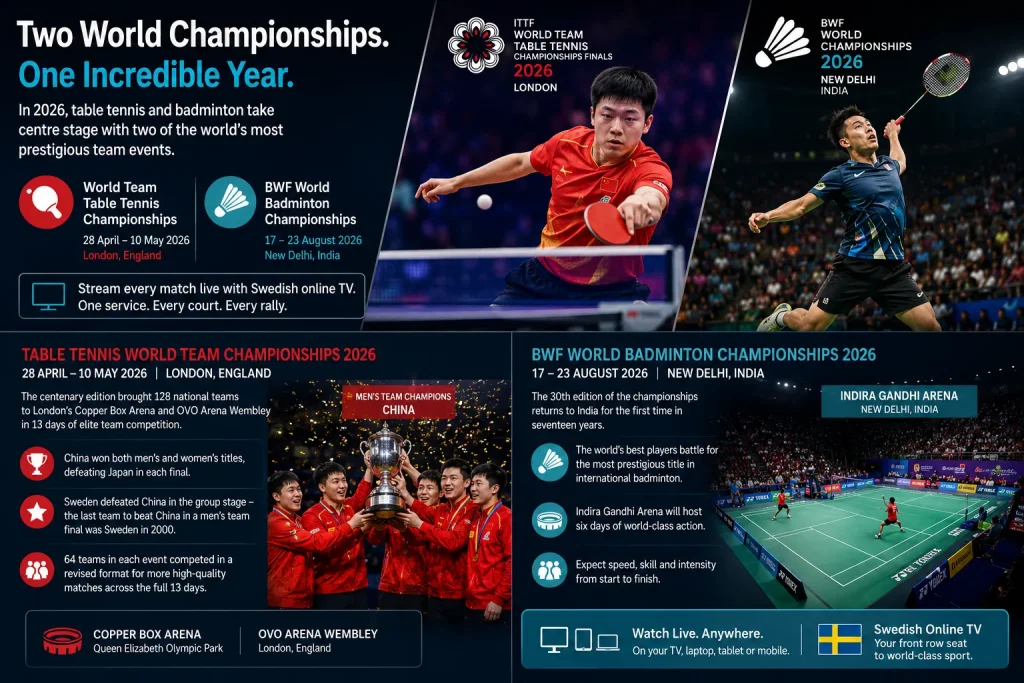
Two of the world’s most technically demanding racket sports are sharing one of their most event-rich years in recent memory. The 2026 World Team Table Tennis Championships took place in London across 28 April to 10 May in a landmark centenary edition that brought 128 national teams to the Copper Box Arena and OVO Arena Wembley. The BWF World Badminton Championships head to New Delhi’s Indira Gandhi Arena 17 to 23 August for the sport’s 30th edition and India’s first hosting of the event in seventeen years. For Swedish fans of both sports, 2026 delivers two of the calendar’s most prestigious racket sport events within the same season — and following them live requires the right online TV service with the channel depth to cover both.
This guide covers everything you need to know about both world championships, what makes each sport worth watching at its highest level, and how to stream every match live through Swedish online TV.
The ITTF World Team Table Tennis Championships Finals 2026 were held at two of London’s most iconic sporting venues the Copper Box Arena in Queen Elizabeth Olympic Park and OVO Arena Wembley from 28 April to 10 May. The centenary edition of the championships marked 100 years of organized world team table tennis competition and brought 64 national teams in both the men’s and women’s events to compete across thirteen days of elite play.
China claimed both the men’s and women’s titles, defeating Japan in each final. The men’s gold extended China’s remarkable record to 24 world team titles, though the path through the knockout stage was not without drama. China’s 26-year winning streak in team matches was broken by South Korea in the group stage, and Sweden defeated China in group play as well — the kind of result that gave the tournament a competitive dimension that had seemed impossible in recent editions. China nonetheless recovered with five consecutive victories in the knockout phase to claim the title. The last team to beat China in a men’s world team final was Sweden, in Kuala Lumpur in 2000.
The world team table tennis championship operates on a logic fundamentally different from individual events. Each tie is played as a best-of-five series of individual singles matches, and the outcome of each match shapes the psychology and tactical decisions for every subsequent game in that tie. A nation does not simply field its three strongest players in descending order the selection, sequencing and tactical awareness of when to deploy which player against which opponent is a strategic discipline in its own right.
The 2026 London championship introduced a revised competition format in which 64 teams in each event were divided into 16 groups of four for the opening stage. The top seven seeded groups plus hosts England entered directly into the second group stage, while the remaining teams competed in a preliminary round to determine who advanced. The knockout phase then ran from the round of 32 through to the medal matches at OVO Arena Wembley.
This format increases the number of meaningful matches for each participating nation and rewards consistent performance across an entire tournament rather than a single knockout run. For the viewer it means that competitive matches are distributed across the full thirteen days rather than concentrated only in the final stages.
Swedish table tennis has a history that extends far beyond domestic pride. Sweden won the men’s world team championship in 1989, 1991, 1993 and 2000 a period of dominance that placed the country among the all-time greats of the team event and produced some of the sport’s most recognizable names. Jan-Ove Waldner, Jörgen Persson and Mikael Appelgren defined an era of Swedish table tennis that shaped how the global game was played.
The current generation carries that legacy. Truls Möregårdh won a bronze medal in men’s singles at the 2025 World Table Tennis Championships in Doha and has established himself as one of Europe’s most dangerous individual players. His presence in the London team and his ability to defeat players outside the Chinese hierarchy gives Sweden relevance in international competition that goes beyond nostalgia for past titles. Following Sweden at world championships is following a programme that has genuinely contributed to the sport’s history and continues to produce players capable of competing at the highest level.
The 30th edition of the BWF World Championships takes place at Indira Gandhi Arena in New Delhi, India, 17 to 23 August 2026. It is India’s first hosting of the event since the 2009 championships in Hyderabad, and the first time the World Championships have been held in Asia since Nanjing, China, in 2018. The tournament covers five individual events — men’s singles, women’s singles, men’s doubles, women’s doubles and mixed doubles — across seven competition days, awarding the highest number of BWF ranking points of any event on the annual calendar.
New Delhi and the Indira Gandhi Arena represent a fitting stage for the return of the World Championships to Asia. The arena has already hosted the 2026 India Open in January, where Lin Chun-yi and An Se-young won the men’s and women’s singles titles respectively, and where the established world order in each discipline showed the depth of competition that the August championships will reflect.
Badminton at world championship level is five separate sports sharing a court. Men’s singles is the discipline of explosive physicality and mental endurance — points are decided in fractions of a second and matches at the later stages can demand three intense games from players operating at the absolute limit of human speed and reaction time. Women’s singles has produced some of the sport’s most technically refined performers and the current generation, led by South Korea’s An Se-young, plays at a level that has consistently broken convention about how fast and how precisely the women’s game can be executed.
Men’s doubles is arguably the most athletically demanding discipline in badminton — the court coverage required at the top level, combined with the coordination between two players moving simultaneously at maximum speed, creates a visual intensity that is unlike anything else in racket sport. The Liang Weikeng and Wang Chang pairing, which won the men’s doubles at the 2026 India Open, represents the current benchmark. Women’s doubles rewards a different combination of skills patience, angle creation and the ability to construct point-winning sequences over multiple shot exchanges. Mixed doubles brings everything together in a format where tactical variation and the management of gender-specific court zones adds an additional strategic dimension.
Before the New Delhi World Championships, the European Badminton Championships in Huelva, Spain, 6 to 12 April 2026 provided a direct measure of where European players stand ahead of the global event. Christo Popov won the men’s singles title and Kirsty Gilmour took the women’s singles crown, while the mixed doubles title went to the Danish pair of Mathias Christiansen and Alexandra Bøje. The European results give Swedish fans a clear picture of who among the continental players arrives in New Delhi with form and confidence and who is building toward their peak.
The 26th edition of the BWF World Junior Championships takes place in Cairo, Egypt, 5 to 17 October 2026, with the Suhandinata Cup team event running 5 to 10 October. The junior championships are the most important long-term indicator of where badminton talent is developing globally and which nations are building the players who will compete at senior world level within the next three to five years.
Following world championship table tennis and badminton through online TV places specific demands on your streaming service that are worth understanding clearly before the tournaments begin.
Channel coverage is the foundation. The broadcast rights for the ITTF World Team Championships in London and the BWF World Championships in New Delhi are held by specific international sports channels and the sports’ own streaming platforms. A Swedish online TV service with broad international channel coverage increases the likelihood that the channels carrying live match rights are available within your subscription. Verify the specific channel access for both events before committing to a service rights distribution for racket sports can vary significantly between platforms.
Picture quality matters in both sports in ways that are technically specific. Table tennis at world championship level is one of the fastest ball sports in existence. The ball travels at speeds that require Full HD playback for the viewer to actually track its path, read spin direction and understand the geometry of shot placement. A compressed lower-resolution feed makes world championship table tennis genuinely harder to follow as a spectator. Badminton similarly benefits from Full HD, where the shuttle’s arc, the footwork patterns and the net play at tight angles are all significantly more readable than in lower resolutions.
Stability during peak streaming hours is the third requirement. World championship finals attract large audiences and the infrastructure behind your streaming service is tested precisely when the matches matter most. A service that performs well under everyday conditions but struggles under championship final load is inadequate for the viewing experience you are actually trying to achieve.
With iptvkungen.net you get access to a Swedish online TV service that covers table tennis and badminton with the international channel breadth, Full HD delivery and technical stability that world championship competition demands — across Smart TV, mobile, tablet and laptop throughout the full 2026 season.
Understanding the full value of a comprehensive online TV service for racket sports in 2026 requires mapping what the year actually contains across both sports.
January and February lay the groundwork. The 2026 India Open in New Delhi 13 to 18 January opens the BWF Super 750 series with early indicators of form heading into the World Championships later in the year. The Badminton Asia Team Championships in Qingdao 3 to 8 February, where Japan won the men’s title and South Korea the women’s, set the early competitive hierarchy in the continent that will host the World Championships in August.
March and April bring the European dimension. The European Badminton Championships in Huelva 6 to 12 April confirms which European players are heading into their peak form year. The Badminton Asia Championships in Ningbo, China, 7 to 12 April — where Shi Yuqi won the men’s singles and An Se-young the women’s — provides Asia’s definitive pre-World Championship form guide.
April and May are defined by the World Team Table Tennis Championships in London. Thirteen days at the Copper Box Arena and OVO Arena Wembley with 128 national teams producing the year’s most comprehensive measure of where every table tennis nation stands relative to the Chinese standard.
June and July are the preparation months for the BWF World Championships. The Super Series circuit continues with high-ranking tournaments feeding into the world ranking standings that determine seedings for New Delhi. Players managing their form peak are building toward the August showpiece.
August is the BWF World Championships. Seven days in New Delhi from 17 to 23 August, five disciplines, and the highest-ranked event on the annual badminton calendar. The medals won at Indira Gandhi Arena carry more ranking weight and historical significance than any other tournament of the year.
September and October bring the BWF World Junior Championships in Cairo from 5 to 17 October — the tournament that identifies the next generation of players who will compete for world titles in the years ahead. The table tennis calendar continues with World Tour events and the groundwork begins for the following year’s individual World Table Tennis Championships.
November and December close the year with BWF Super Series Finals and the World Table Tennis Cup Finals, consolidating the season’s competitive results into final year-end rankings and providing the last live championship viewing opportunities before 2027 begins.
Streaming world championship table tennis and badminton across a full season does not require exceptional technical infrastructure, but the baseline requirements are worth knowing in order to avoid avoidable disruptions at the wrong moment.
A stable download speed of 10 Mbps is sufficient for Full HD streaming of both sports. The key word is stable rather than fast. A connection that peaks at high speeds but drops periodically during a rally is functionally worse than a consistent lower-speed connection — particularly in table tennis, where a dropped frame during a fast exchange can mean losing track of the score entirely. For the most important matches, a wired Ethernet connection to your Smart TV or streaming device eliminates the WiFi interference that occasionally affects performance in apartment buildings with dense wireless environments.
Data consumption for a table tennis team tie lasting approximately 90 minutes in Full HD runs around 5 to 6 GB. A badminton final going to three games over 80 minutes consumes a similar amount. A full day of championship coverage with multiple matches from both sports can consume 15 to 20 GB. Home broadband in Sweden handles this without difficulty for the vast majority of households, but mobile data users should account for consumption during multi-day championship windows.
For 4K content, where available from the broadcasting channel, a sustained connection of 25 Mbps or above and a display capable of rendering that resolution are required. The additional resolution is particularly visible in badminton, where the shuttle trajectory and court geometry benefit from the increased detail.
Yes, if the package includes the right sports channels.
Yes, those devices are usually compatible.
Approximately 5 to 6 GB for a 90-minute best-of-five team tie at 1080p.
Yes, most services offer catch-up or replay within 24 to 48 hours.
Yes, if your plan supports simultaneous streams.
No, monthly subscriptions without long-term contracts are standard.
A stable 10 Mbps connection is sufficient stability matters more than peak speed.
This depends on the service’s geographic terms check before travelling internationally.
The ITTF World Team Table Tennis Championships ran 28 April to 10 May in London. The BWF World Badminton Championships run 17 to 23 August in New Delhi. The BWF World Junior Championships follow in Cairo in October. Together they form a racket sports calendar that spans the entire year and delivers championship-level competition from January through December.
Both table tennis and badminton at world championship level are sports that reveal their depth and complexity through sustained live viewing. The speed of a table tennis exchange is only fully comprehensible in real time. The footwork and court geometry of a badminton final only make full sense when you watch the point as it is constructed from first serve to winning shot.
There is no other format that does justice to either sport. Highlights compress the wrong moments. Results notifications skip the context that makes the result meaningful. Live streaming, in Full HD, from first point to championship match point that is the only version worth watching.

Jag är Damian Cross, en skribent inom streamingteknik med fokus på OTT-plattformar, videodistribution, streamingprestanda och innovationer inom digitala medier.


