

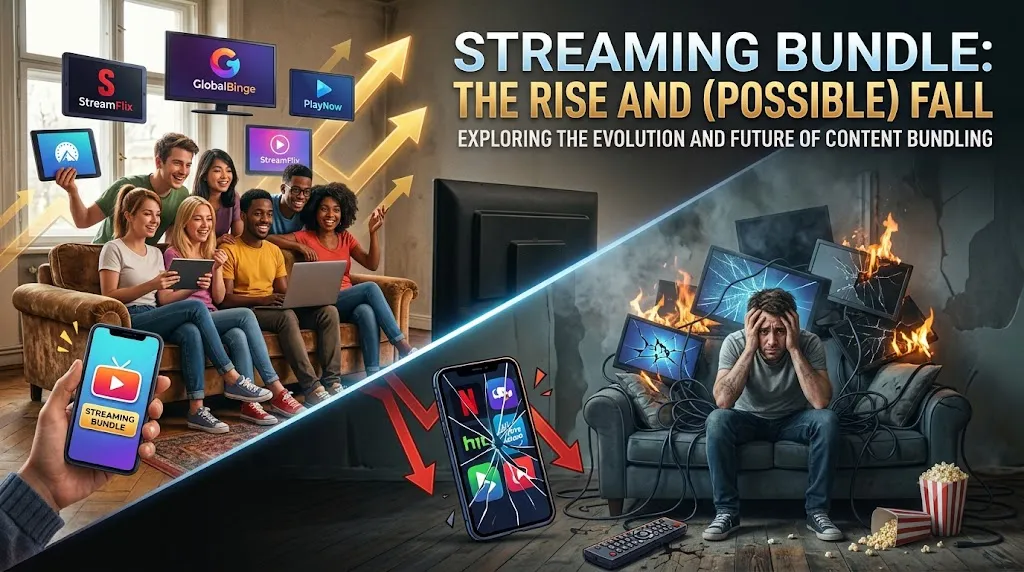
Just a few years ago, the future looked simple. A streaming bundle, a package combining several services under one subscription, was supposed to save us from cable TV’s high prices and confusing contracts. Today, the picture looks a lot more fragmented. Prices keep climbing, content shuffles between packages, and more and more households are asking whether the streaming bundle model actually delivers on what it promised.
In this article, we’ll look at how the streaming bundle trend took off, why it became so popular, what problems have started to surface, and what you should think about before signing up for a new package.
A streaming bundle is simply a package deal where several streaming services, or several features within a single service, are sold together for one combined price. Instead of paying separately for movies, series, sports, and music, you get it all under one subscription.
There are generally three common types of streaming bundle:
What all these variants share is the promise of simplicity: fewer bills, one interface to manage, and often a lower total cost than paying for each service individually.
The streaming bundle concept became popular for several good reasons, and it’s worth understanding them before writing the trend off entirely.
Keeping track of five or six separate streaming accounts, each with its own billing date and login, quickly became a headache for many households. A streaming bundle solved that by putting everything in one place.
As more and more services launched their own exclusive shows and movies, subscribing to all of them separately started to feel unreasonably expensive. A bundled deal made it possible to access far more content without the cost rising at the same rate.
Telecom companies and internet providers quickly realized that a built-in streaming bundle made it harder for customers to switch providers. By tying streaming services to a broadband or mobile plan, they created a stronger relationship with the customer, and one more reason to stay.
For major media companies, bundling offered a way to reach more paying viewers, especially those who might otherwise have skipped the service altogether due to price. That made the streaming bundle an attractive tool for content providers themselves, not just distributors.
So why are more and more people talking about a possible “fall” for the streaming bundle? It’s rarely down to a single cause. It’s usually several trends reinforcing each other.
Many streaming packages that once looked like fantastic deals have gradually raised their prices, year after year. For some households, the gap between paying for a bundle and paying for each service separately isn’t that big anymore.
One of the biggest complaints is that what’s included in a streaming bundle changes without warning. A show that was part of the package in January might be gone by March, because the rights were sold elsewhere or the content moved to a different platform. That makes it harder to trust that you’re actually getting what you’re paying for over time.
Ironically, the solution to “too many subscriptions” has, in some cases, become “too many bundles.” When every provider and every media giant has its own package deal, you end up back at square one: a patchwork of contracts, prices, and terms to compare.
One thing that often gets overlooked in price comparisons is the actual streaming experience itself. Buffering, low resolution, and dropouts can ruin even the best content lineup, no matter how good the package looks on paper. Before signing up for a new streaming bundle, it’s worth looking into what kind of internet connection and network setup you’ll need for a stable experience, rather than comparing only price and channel count.
The answer largely depends on your household’s viewing habits. A streaming bundle can still be a smart choice, but only if you do your research before committing.
Sports is a good example of an area where viewing habits differ sharply from regular movies and series. Fans of niche sports like skiing or snowboarding often want access to specific live broadcasts rather than a broad general lineup, and may need to look at dedicated sports packages or individual services outside the typical streaming bundle model to get that coverage.
Before signing up for a new streaming package, take the time to compare the following points across your options:
The trend points toward a more nuanced future rather than a total collapse of the streaming bundle as a concept. Several developments are becoming more common:
In other words: the streaming bundle model probably isn’t disappearing. It’s evolving to meet a more price-conscious and skeptical audience.
The streaming bundle phenomenon was born out of a real need: to simplify an increasingly fragmented streaming market and make it more affordable. The rise was fast and logical. But as prices have climbed, content has shifted around, and the number of competing packages has grown, many consumers have started to question whether a streaming bundle is really the simple solution it once was.
The answer is rarely a blanket yes or no. It comes down to understanding your own viewing habits, comparing terms carefully, and being willing to switch if a package no longer delivers value for money. Do that, and a streaming bundle can still be a smart, cost-effective way to access a lot of entertainment in one place.
Want to stay up to date on how the streaming market is evolving, and get more practical guides on streaming quality and live sports? Keep exploring our guides to make smarter choices the next time you sign up for a streaming package.
A streaming bundle is a package deal where several streaming services, or several features within one service, are combined under a single subscription and price, instead of paying for each service separately.
Not necessarily. The price may be lower at first, but many packages raise their fees after an introductory period. It’s important to compare the long-term total cost, not just the starting price.
This usually happens because the rights to a movie or show have been sold to another company, or the agreement between the content owner and the platform has expired. This is outside your control as a subscriber.
Look at your actual viewing habits. If you regularly use several of the services in the package and share it among multiple people, it usually pays off. If you mostly watch one service, separate subscriptions may offer better value.
Probably not. The model is more likely to shift toward more flexible, customizable packages, ad-supported options, and closer partnerships with providers, rather than disappearing altogether.

Jag är Damian Cross, en skribent inom streamingteknik med fokus på OTT-plattformar, videodistribution, streamingprestanda och innovationer inom digitala medier.


